Fresh Egg Pappardelle with White Ragù
Nothing wasted
When you make your own ricotta, you are left with a pot of whey. Most people pour it away. I braise a ragù in it. Whey is gently acidic and full of milk proteins, so it tenderizes the meat as it simmers and reduces into a light, savory sauce with a subtle creaminess you can't get from stock.
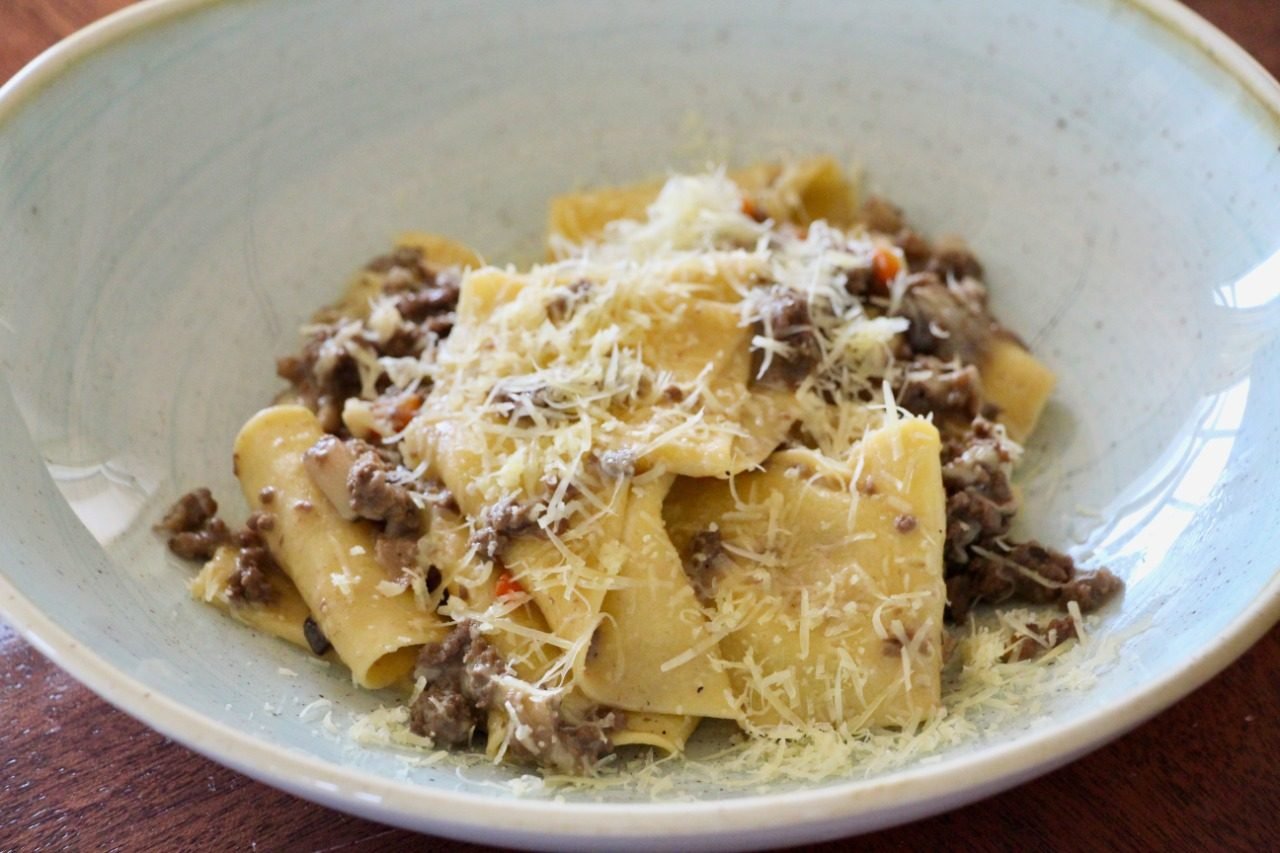
This is a white ragù, ragù bianco: no tomato, just well-browned pork and beef, a soffritto, white wine and herbs, cooked slowly until the meat is tender and the sauce clings. Tossed through wide ribbons of fresh egg pasta with butter and Parmigiano, it's one of the most comforting plates in the Italian kitchen, made from the cheapest cuts and an ingredient most kitchens throw away.
Brown the meat hard and don't stir too soon. In a white ragù there's no tomato to carry the flavor, so the color in the pan is the flavor.
Ragù before the tomato
Ragù is older than the tomato in Italian cooking. The first ragùs, inspired by the French ragoût, were slow braises of meat, wine and aromatics; tomatoes only found their way in during the 18th and 19th centuries. In Tuscany and Emilia-Romagna, white ragùs of pork, veal or game are still cooked this way today.
Pappardelle take their name from pappare, Tuscan dialect for "to gobble up." Their width makes them the classic partner for rich, chunky ragùs. Using whey in the pot follows the same thinking as ricotta itself, which was invented to use up whey: in a thrifty kitchen, nothing goes to waste.
Step by step
- Brown the meat.
Pork, beef and pancetta browned hard in batches.
- Build the soffritto.
Onion, carrot, celery and garlic softened in the fat.
- Braise in whey.
White wine reduced, then whey and herbs, simmered for 1½ to 2 hours.
- Make the pasta.
Flour and eggs, rested, rolled thin and cut into wide ribbons.
- Toss and serve.
Pasta, ragù, butter, pasta water and Parmigiano.
Rick's rules
Dry meat, hot pan, small batches. Crowd the pan and the meat steams gray instead of browning.
Simmer, don't boil. The whey should barely bubble. A hard boil makes the meat tough.
Rest the dough. Thirty minutes wrapped at room temperature relaxes the gluten so it rolls out easily.
Finish the pasta in the sauce. Toss the pappardelle in the ragù with a splash of pasta water for a minute so the sauce clings.
Grate the cheese fine. A snowfall of finely grated Parmigiano melts into the ribbons; coarse shreds sit on top.
Questions I get asked
What if I don't have whey?
Use the same amount of chicken stock with a splash of whole milk added for the last 30 minutes.
Can I use store-bought pasta?
Yes. Use fresh egg pappardelle from the chiller cabinet, or dried egg pappardelle or tagliatelle. Cook according to the package and finish in the sauce the same way.
Can I make the ragù ahead?
Yes, and it improves. It keeps 3 days in the fridge and freezes for 3 months.
Can I make the pasta without a machine?
Yes. Roll it out with a long rolling pin as thinly as you can, dust with flour, fold it loosely and cut into wide strips with a knife.
Fresh Egg Pappardelle with White Ragù
Method
- Brown the meat. Heat the olive oil in a heavy casserole over medium-high heat. Add the pancetta and cook until it renders. Add the pork and beef in batches, pressing them flat and leaving them undisturbed until deeply browned, then break up. Season and set aside.
- Make the soffritto. Lower the heat to medium, add the onion, carrot and celery and cook for 8 to 10 minutes until soft and golden. Add the garlic and cook 1 minute more.
- Braise. Return the meat to the pan with the rosemary and sage. Pour in the wine and let it bubble until almost gone, scraping up the browned bits. Add the whey and nutmeg, bring to a gentle simmer, partly cover and cook for 1½ to 2 hours, stirring now and then, until the meat is tender and the liquid has reduced to a glossy sauce. Add a splash of water if it gets too dry. Discard the herbs and check the seasoning.
- Make the pasta dough. Mound the flour on a board, make a well, crack in the eggs and add the salt. Beat the eggs with a fork, gradually drawing in the flour, then knead for 8 to 10 minutes until smooth and silky. Wrap and rest for 30 minutes.
- Roll and cut. Divide the dough into four. Roll each piece through a pasta machine, working down to the second-thinnest setting. Dust with flour, fold loosely and cut into ribbons about 1 inch (2.5 cm) wide. Toss with flour and spread out on a tray.
- Cook the pasta. Cook in a large pot of well-salted boiling water for 2 to 3 minutes, until tender. If using store-bought pasta, cook according to the package. Reserve a cup of the pasta water.
- Toss and serve. Add the drained pasta to the ragù with the butter and a splash of pasta water and toss over low heat for 1 minute, until the sauce clings. Take off the heat and toss in the Parmigiano. Serve in warm bowls with more Parmigiano grated finely over the top.
Notes
Where the whey comes from: the homemade ricotta for my grilled asparagus gives you about 3 cups, more than enough for this ragù.
Make ahead: the ragù keeps 3 days in the fridge; fresh pasta can be cut, dusted and frozen on a tray, then cooked from frozen.
Serve with: a glass of Chianti Classico or Sangiovese.
Tried this recipe?
Tell me how yours turned out, what you changed, or ask me a question. I read every comment.
No comments yet. Be the first to tell me how it went.